
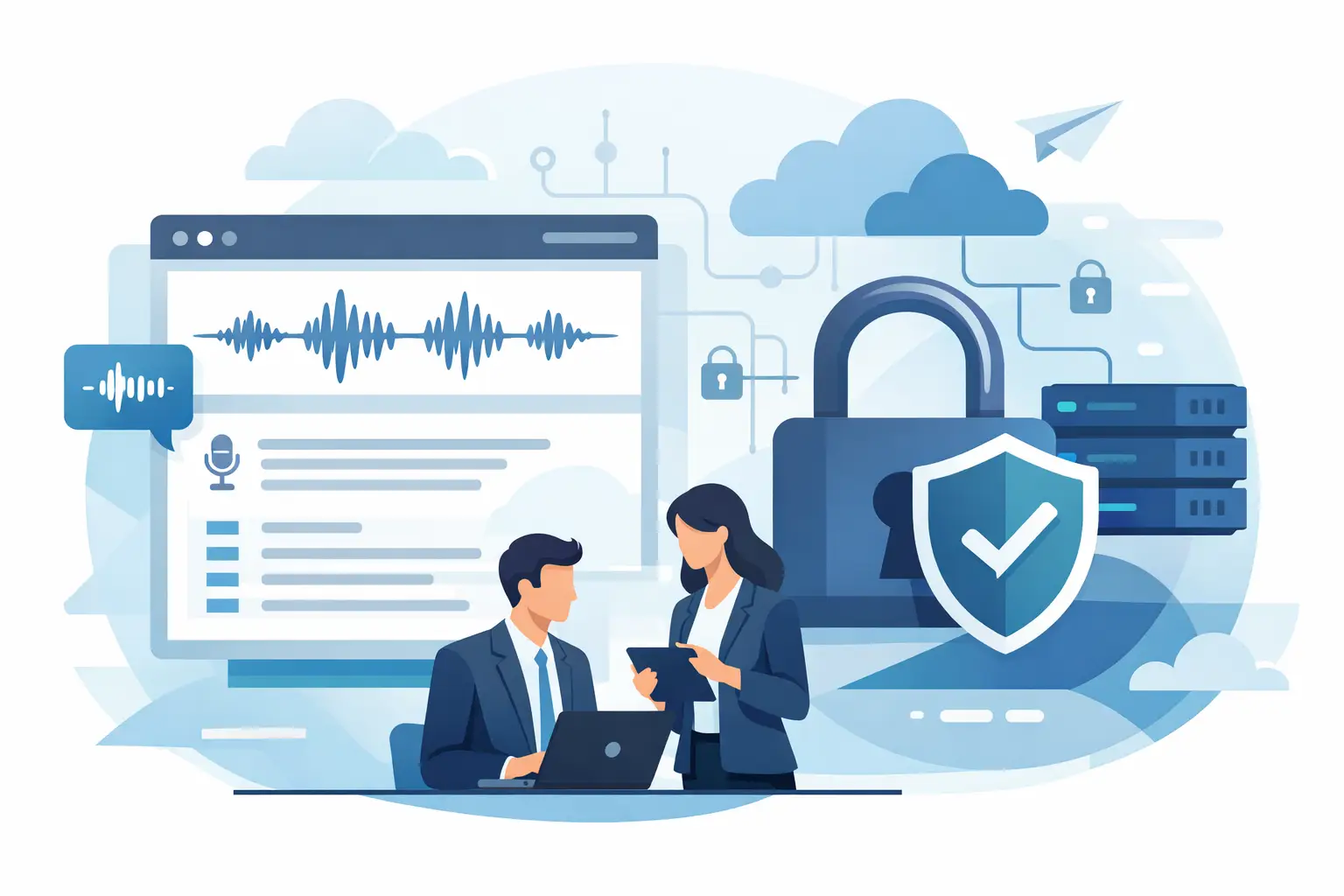
A browser tab is often where sensitive work begins: an interview with a source, a client debrief, a research session, or a team call containing commercial decisions. So, is browser transcription secure? It can be, but the browser itself is only one part of the answer. Security depends on what happens to the recording after you press Start, who can access it, how long it remains available, and what the provider is permitted to do with your content.
For professionals, the useful question is not whether browser-based transcription is inherently safe or unsafe. It is whether a specific service gives you enough control over confidential spoken information to use it responsibly.
Is browser transcription secure by default?
No. A browser is simply the interface through which you record audio, upload a file, review a transcript, and export the result. It does not tell you where the audio is processed, whether it is stored, or how the platform handles staff access and AI training.
A well-designed browser transcription service can provide strong protections. The practical advantage is that there is no separate desktop application to install, maintain, or update across every device. The potential downside is that users can mistake convenience for assurance. A clean interface and a fast transcript do not, by themselves, prove that the underlying data handling meets professional standards.
The level of security you need also depends on the material. A public podcast recording has a different risk profile from a journalist’s unpublished interview, a coaching session, an internal strategy meeting, or research involving participants. If your work includes personal data, commercially sensitive information, or material subject to confidentiality obligations, security settings and provider commitments should be part of the buying decision, not an afterthought.
What happens to your audio in a browser transcription tool?
When you record or upload through a browser, the audio normally travels over the internet to the transcription provider’s systems for processing. The resulting transcript, timestamps, speaker labels, summaries, and bookmarks may then be stored in your account until you delete them or a retention policy removes them.
That workflow creates several points to assess. Data needs protection while travelling between your browser and the service, while being processed, and while stored. Access also needs to be controlled at the account level. A secure password is useful, but it is not enough if somebody gains access to an already signed-in device or a reused credential.
Processing location matters too. Organisations that work with UK or European data may need clarity on whether information is processed in the EU, transferred elsewhere, or made available to overseas sub-processors. This is particularly relevant when the recording includes identifiable people, health information, legal discussions, financial details, or confidential research.
Do not assume that an AI transcription product treats every upload as private simply because it is in a personal workspace. Read the provider’s terms and privacy information for a clear answer on storage, processing, deletion, and model training.
The security checks that matter most
For day-to-day professional use, a few controls make a meaningful difference. They are more useful than vague claims about being “secure”.
Encryption in transit and at rest
Your recording should be protected while it moves from your browser to the service and while it is held on the provider’s systems. Encryption in transit helps prevent interception over the network. Encryption at rest protects stored files and transcripts if storage systems are compromised.
These measures are foundational, not optional extras. Ask the provider to state them plainly. If its security information is difficult to find or relies on broad marketing language, treat that as a reason to investigate further.
Strong account protection
Transcripts are often more searchable, shareable, and revealing than the original audio. That makes account security essential. Two-factor authentication adds a second check beyond a password, reducing the risk that a leaked or reused password gives someone access to your recordings.
For teams, consider how workspace access is managed as well. Can you remove a former contractor promptly? Are recordings visible only to the people who need them? Can shared minutes, files, and exports be governed without passing documents between personal accounts? These are operational security questions, but they are also productivity questions when a team has to manage work at pace.
Retention and deletion controls
Every stored recording is an asset and a liability. Keeping material forever may feel convenient until you need to explain why a sensitive interview or client call remained available months later.
Look for explicit retention windows and straightforward deletion controls. You should know whether deleted content is removed from your workspace immediately, what happens to it in backups, and whether the service retains it for a defined period. A provider that makes retention clear gives you a practical way to align transcription with your own records policy.
No training on customer content
This is one of the most significant distinctions between transcription services. Some AI products may use user inputs to improve models unless you opt out, change a setting, or qualify for a particular plan. That may be unsuitable for professional recordings, especially where contributors have not consented to that use.
Choose a provider that clearly states whether customer audio and transcripts are used for AI model training. A direct commitment not to train on your content reduces uncertainty and makes it easier to explain your process to clients, interviewees, and colleagues.
Clear processing geography
Where processing takes place can affect procurement, contractual commitments, and privacy assessments. UK businesses may have different requirements from a global media creator, and regulated organisations may require more detail still.
If location matters to your work, ask specifically where AI processing occurs and whether recordings are transferred to the United States or other jurisdictions. An EU-based processing model with no US data transfers may be a better fit for teams that want more predictable data governance.
Browser risks still sit with the user
Even a careful transcription provider cannot secure a device that has been left unlocked in a shared office, a recording made over an unsafe public connection, or a transcript exported to an uncontrolled folder.
Use a current browser and operating system, lock your device when away from your desk, and avoid recording sensitive meetings on shared computers. Check the web address before signing in, particularly if you arrive from an unexpected email or message. Phishing attacks commonly target accounts that hold valuable business information.
Be deliberate with exports as well. A Word document, text file, or subtitle file can be copied outside the platform’s permissions. Export only what is required, store it in an approved location, and remove local copies when your records policy calls for it. For an interview or research project, it may be safer to share an edited extract than the full raw transcript.
Consent should form part of the workflow. Tell participants when a conversation is being recorded and transcribed, explain the purpose, and follow the policies that apply to your organisation or project. Security protects data from unauthorised access. It does not replace lawful, transparent handling of the data you collect.
A practical standard for professional transcription
For many working teams, the right service combines fast transcription with controls that are easy to apply under pressure. You should be able to record a meeting, receive a timestamped transcript in seconds, correct names or technical terms, identify speakers, and export the finished record without giving up visibility over the data lifecycle.
Endaxi Scribe is built around that professional workflow, with two-factor authentication on every plan, explicit retention windows, no AI model training on customer content, and EU-based AI processing without US data transfers. Those commitments matter because transcription is not merely a convenience feature. It becomes part of how you document decisions, report conversations, and retain evidence of work.
Security will never mean that every recording belongs in every tool. Highly restricted material may require additional contractual controls, internal approval, or a different process entirely. But for regular interviews, calls, research sessions, coaching notes, and team discussions, browser transcription can be a sound choice when the provider is transparent and users handle accounts, access, and exports with care.
Before your next recording, take two minutes to check the service’s training policy, retention terms, processing location, and account security options. That small decision can protect the conversation long after the browser tab is closed.