
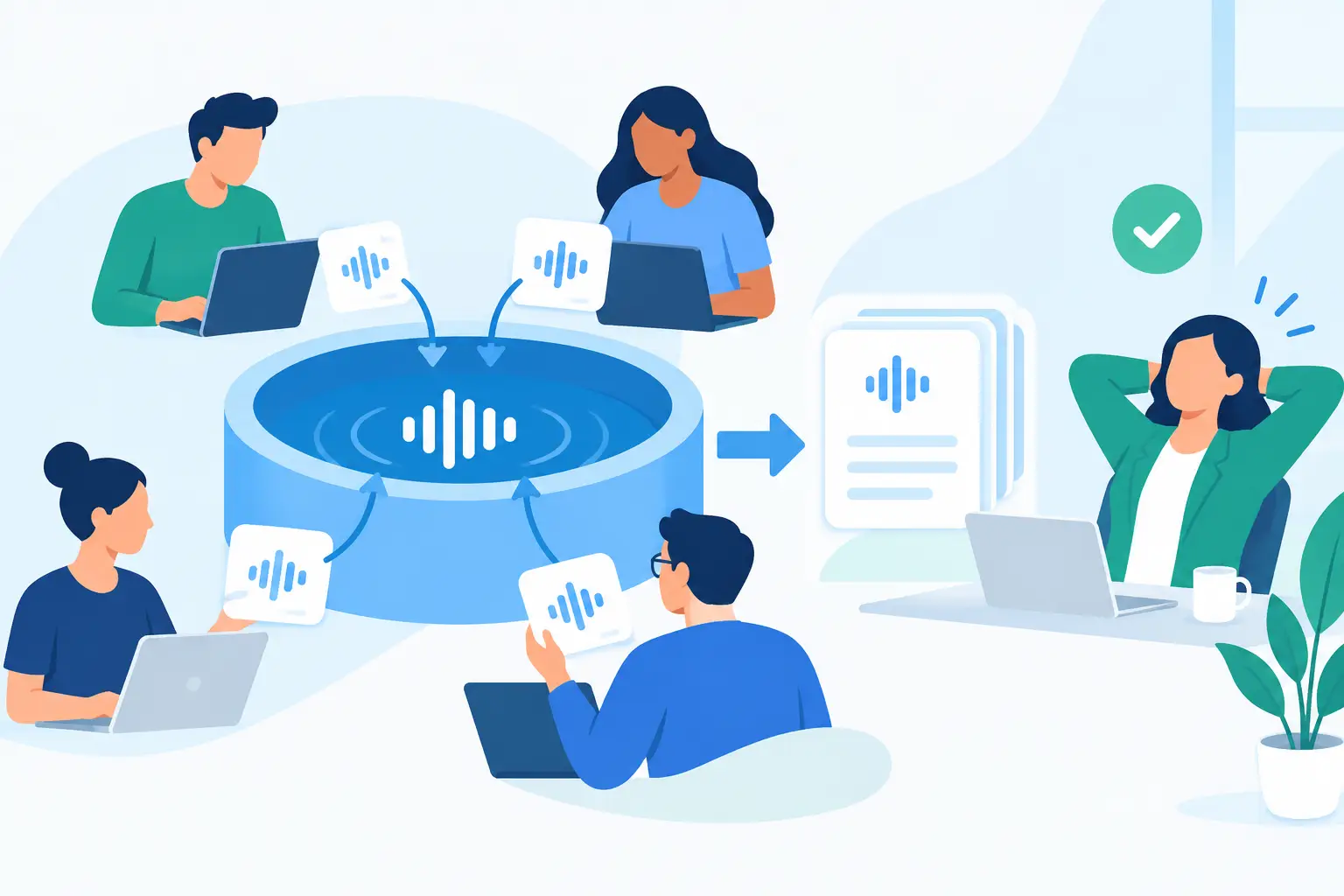
A research lead has an urgent interview to upload. A consultant needs a client call transcribed before the follow-up. Meanwhile, a colleague has minutes left on an individual plan that will expire unused. This is the operational problem pooled transcription plans are designed to solve: they put a shared transcription allowance where the work happens, rather than dividing it into rigid personal quotas.
For teams that work with the spoken word, transcription demand is rarely even. One person may need several hours for a research project this month; another may only transcribe a weekly meeting. A pooled approach makes that variation manageable while giving the organisation clearer control over cost, access and data handling.
What pooled transcription plans mean in practice
A pooled plan gives a workspace or team a single allowance of transcription minutes. Approved members draw from that balance when they record live speech or upload an audio or video file. The allowance belongs to the organisation, not to one employee’s account.
That distinction matters. With separate individual subscriptions, capacity is often stranded. Heavy users hit a limit while light users retain minutes they do not need. Administrators then have to change plans, reimburse expenses or ask people to postpone work. A shared pool directs available capacity to the next piece of work that needs it.
The model is particularly useful when workloads change from week to week. Journalists may transcribe heavily around a major story. Researchers can have intense fieldwork periods followed by analysis. A small consultancy may see a rush of discovery calls at the start of a project. In each case, usage is driven by live work rather than a predictable personal allowance.
Where a shared minute allowance earns its keep
The clearest benefit is less administration. Instead of managing several subscriptions and checking individual balances, a team manages one resource. Staff can focus on recording, uploading, reviewing and exporting transcripts without having to decide whose plan should cover a particular file.
It also makes spend easier to understand. A pooled allowance creates a direct view of team-level consumption. If usage rises, that is a useful signal: perhaps the team is conducting more interviews, holding more client conversations or producing more recorded content. If usage is consistently low, the organisation can reassess its capacity rather than continuing to pay for unused individual entitlements.
There is a practical workflow gain too. A shared workspace brings related work into a more consistent environment. Team members can use the same transcription process, review speaker-labelled text, add bookmarks to significant moments and export a transcript in the format required for the next stage of work. That consistency is valuable when a project passes between colleagues.
For example, a market research team might upload customer interviews as they are completed. The moderator can check the transcript while the conversation is fresh, an analyst can locate comments by timestamp, and a project lead can review recurring themes without listening back to every full recording. The team uses one allowance, but the transcript becomes a shared working record.
Pooled transcription plans are not only a pricing decision
A shared allowance solves a billing problem, but it also introduces governance questions. When more people can use the same transcription resource, the organisation needs to be clear about who can access recordings, who can invite new members and how long sensitive material should remain available.
That is why a suitable platform should support the way professional teams actually work. The priority is not merely converting speech into text quickly. It is ensuring that recordings, transcripts and account access are handled with appropriate control.
For teams working with confidential interviews, commercial calls or personal coaching sessions, ask practical questions before choosing a plan:
- Is two-factor authentication available for every user?
- Can the organisation set and understand retention periods for recordings and transcripts?
- Is customer content excluded from AI model training?
- Where is the AI processing carried out, and are data transfers outside the required region involved?
These are operational requirements, not legal fine print. A transcript can contain commercially sensitive statements, identifiable participant information or material subject to research and client obligations. Faster transcription is useful only if the handling of that material matches the standards expected by the organisation.
Endaxi Scribe, for example, combines pooled workspace minutes with two-factor authentication, defined retention controls, no training on customer content and EU-based AI processing without US data transfers. For many teams, that combination is as relevant as speed and accuracy.
How to set up a pool without losing control
Start with the work, not the number of users. Count the conversations that genuinely need a written record: interviews, internal meetings, client calls, coaching sessions, recorded presentations and dictated notes. Then consider their average length and how often they occur. This produces a more useful estimate than simply multiplying a notional allowance by the size of the team.
Next, define who needs workspace access. Not everybody who reads a transcript needs to upload source files or manage the plan. Separating day-to-day users from administrative responsibility reduces accidental sharing and keeps account management straightforward.
It is also worth agreeing a simple naming convention before the first batch of files arrives. A format such as project name, date and participant or meeting type makes transcripts easier to find later. Consistent names, speaker diarisation and timestamps reduce the time spent asking which recording is the right one.
Finally, establish a review habit. For high-stakes material, the person closest to the conversation should scan names, technical terms, figures and quoted statements before the transcript is circulated or exported. Automated transcription removes hours of manual typing, but a short human review remains sensible where precision affects a decision, publication or client record.
When individual plans may be the better fit
Pooling is not automatically right for every organisation. A sole professional with regular, predictable usage may prefer an individual plan with a fixed allowance. The same can apply to a distributed network of independent contractors who do not need a shared workspace or access to each other’s transcripts.
Separate plans can also suit cases where strict client separation is required and there is no operational reason to collaborate. In that situation, distinct accounts may be simpler than creating shared access rules around a common pool.
The question is whether transcription is an individual productivity tool or a team resource. If work moves between people, demand varies and the organisation wants one view of usage, pooled minutes usually make more sense. If usage and responsibility stay entirely with one person, an individual plan may be cleaner.
Measuring whether the plan is working
After the first month or two, review patterns rather than judging the plan on a single busy week. Look at how much of the allowance is used, which types of work consume the most minutes and whether people are creating transcripts early enough to act on them.
A healthy outcome is not simply maximum consumption. It is fewer bottlenecks. Interviews are transcribed while context is fresh, meeting actions are easier to verify, and teams spend less time replaying recordings or manually compiling notes. If a pool is being exhausted unexpectedly, investigate the cause before increasing capacity. It may reflect legitimate growth, but it may also show that long recordings are being uploaded without a clear purpose or that a workflow needs clearer guidance.
Shared transcription works best when it is treated as part of the team’s information practice, alongside sensible access controls, file naming and review standards. Put the allowance at the workspace level, keep control with the organisation, and let the people doing the work use it when the spoken detail matters most.