
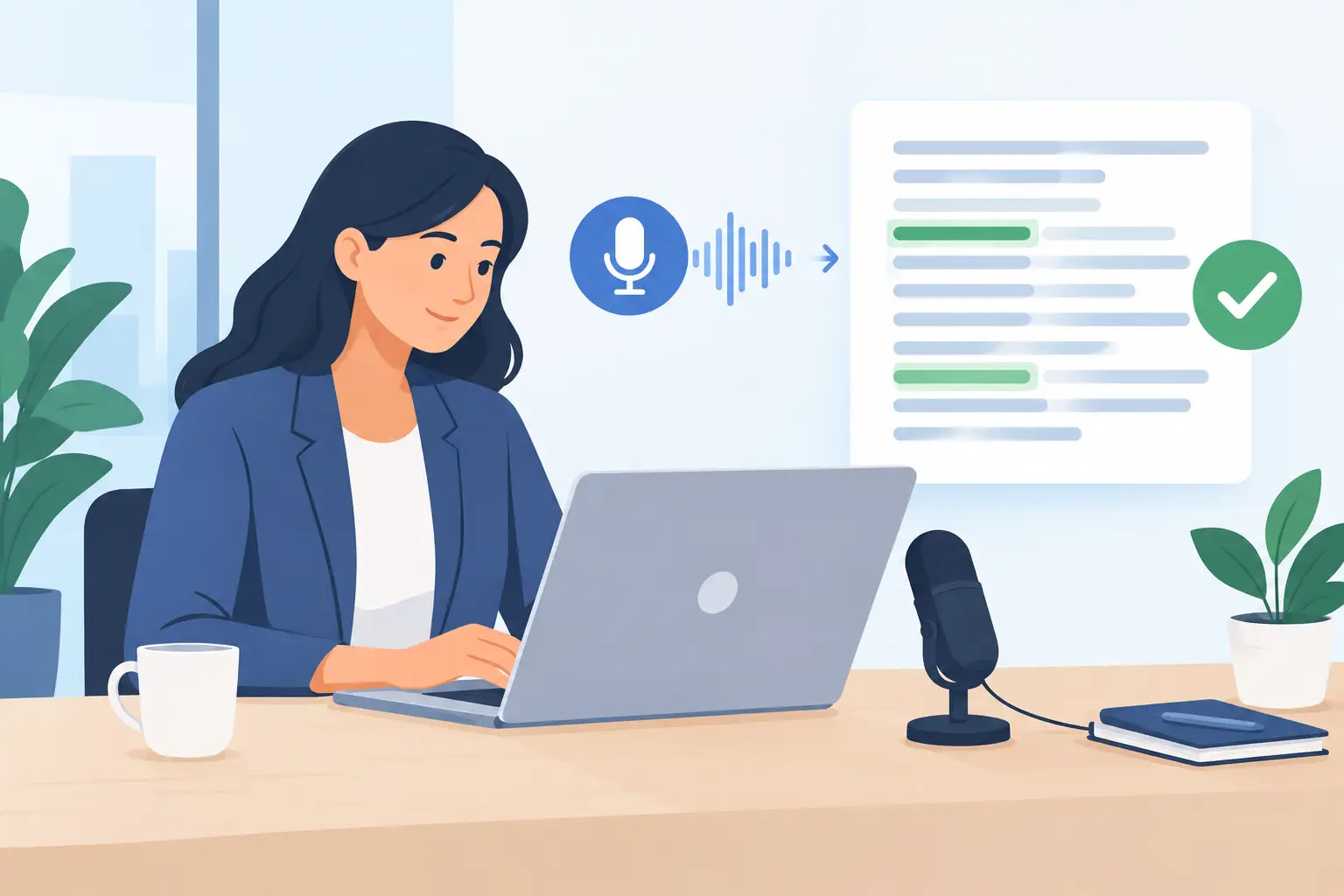
A missed name in an interview, an incorrect figure in a client call, or two speakers merged into one paragraph can change the meaning of a record. To improve transcript accuracy, start before anyone speaks. The quality of the audio, the way participants contribute, and the review process all affect the final text.
For working professionals, accuracy is not about achieving a perfect automated draft with no input. It is about producing a reliable, searchable record quickly, then focusing human attention on the moments where context and precision matter most.
Improve Transcript Accuracy Before Recording
Speech-to-text systems work from the signal they receive. Clear speech in a quiet room will produce a materially better result than distant voices, traffic noise and several people talking at once. This is the most controllable part of the workflow.
Use the best microphone available, but prioritise placement over price. A modest headset microphone positioned close to the speaker will often outperform a laptop microphone at the far end of a meeting table. For in-person interviews, place the recorder centrally and test the level with a short sample before starting.
Room choice matters too. Hard, open spaces create echo, while cafés, shared offices and meeting rooms beside busy corridors introduce competing voices. If a quiet room is unavailable, move the microphone closer, close doors and windows, and turn off avoidable sources of noise such as fans or notification sounds.
For remote calls, ask participants to use headphones where possible. This reduces echo and prevents one participant’s audio from being picked up twice. A stable internet connection is also useful for live transcription, although recording a local backup can protect an important interview or session if a call drops.
Set expectations at the start
A short instruction can save significant editing time. Ask people to say their name before contributing in a group recording, speak one at a time, and avoid talking over others when a decision, quote or action is being discussed. This is not about making conversation artificial. It gives the transcript a clearer structure when the detail matters.
Names, acronyms, technical terms and product names are common sources of errors. Introduce them clearly at the beginning, spell them out when necessary, and repeat an unusual term rather than assuming it was captured correctly. Researchers and journalists can also state the subject, date and interviewee name aloud at the start, creating a useful reference point in the recording.
Choose the Right Transcription Workflow
Live transcription and uploaded-file transcription serve different needs. Live transcription helps when you need to follow a discussion, take notes, mark key moments or confirm a detail while the conversation is still happening. Uploading a recording suits longer interviews, podcasts, coaching sessions and meetings where the audio has already been captured.
Neither approach removes the need for review. Automated transcription is excellent at turning hours of speech into a usable draft in seconds. It is less reliable when a word depends on specialist knowledge, a speaker has an unfamiliar accent, or several people talk at once. The best workflow treats the transcript as an efficient first pass, not an unexamined final document.
Speaker diarisation can make long discussions far easier to review by separating contributions into individual speaker tracks or labels. It performs best when each person has a distinct voice and overlap is limited. In a lively workshop or a panel with frequent interruptions, labels may need correction. That is still faster than manually locating every change of speaker from the original recording.
If your work involves sensitive conversations, consider where the audio and transcript are processed, how long they are retained, and whether the provider uses your content to train AI models. Convenience is not a sufficient reason to lose control of client, research or source material. A professional platform should make retention and access settings clear, rather than leaving them as an afterthought.
Review the Parts Most Likely to Be Wrong
Reviewing every word from the beginning to the end may be necessary for legal, clinical or publication-ready material. For routine internal notes, it is often inefficient. A risk-based review gives you a better balance between speed and confidence.
Start with the parts that carry consequences: names, job titles, dates, amounts, decisions, commitments, direct quotations and technical language. A transcript can be broadly accurate yet still cause trouble if it changes £15,000 to £50,000 or attributes a comment to the wrong person.
Listen back at normal speed first. Slow the audio only for unclear passages. Repeatedly listening at a reduced speed can make a straightforward edit take longer than it needs to. Timestamped transcripts are particularly useful here, because they take you directly to the relevant section rather than forcing you to search through a full recording.
Watch for words that sound alike but mean different things, especially in business and research contexts. “Principal” and “principle”, “affect” and “effect”, or “there” and “their” may look plausible in isolation. Read a full sentence before correcting a word. Context is usually more reliable than a single phonetic guess.
Keep the spoken meaning intact
Cleaning a transcript does not mean rewriting it into polished prose. Remove obvious verbal clutter if the purpose is a readable meeting note, but retain wording where nuance matters. For a quote, research interview or performance conversation, pauses, hesitation and self-correction may carry meaning.
Decide the standard before editing. A verbatim transcript captures speech as delivered, including false starts where relevant. An intelligent verbatim transcript improves readability while preserving the speaker’s intended meaning. A meeting record may go further, condensing discussion into decisions and actions. These are different outputs, and each requires a different level of intervention.
Build Accuracy Into Team Handover
Accuracy can deteriorate after transcription if files are renamed inconsistently, edits are made in separate copies, or colleagues cannot tell which version is final. Use a clear naming convention that includes the project, date and subject. Keep the audio, transcript and any edited summary associated with the same record.
For shared work, agree who owns the final review. One person may check speaker labels and factual details while another extracts actions or approved quotes. Without that responsibility, teams often assume someone else has verified the text.
Bookmarks are useful when a recording contains specific moments that need follow-up, such as an agreed deadline, a notable quote or a question for legal review. A short label at the relevant timestamp is more useful than a vague note saved elsewhere. It also makes the transcript easier for colleagues to navigate without replaying an entire call.
Export format should match the next task. Plain text may suit research coding, while a formatted document may be better for a client record. If colleagues need to search, edit or archive the content, avoid turning the transcript into an inaccessible image or scattering it across personal folders.
Protect the Conditions for Accurate Work
Privacy and accuracy are connected. When people know a recording is handled responsibly, they are more likely to speak openly and provide the detail needed for a useful record. Conversely, uncertainty about data handling can lead to guarded conversations, incomplete notes and improvised workarounds.
Use appropriate access controls, particularly for interviews, HR discussions, coaching sessions and commercially sensitive meetings. Limit access to people who need the material, use two-factor authentication, and set retention periods that reflect the purpose of the recording. Delete audio and transcripts when there is no longer a legitimate reason to keep them.
Endaxi Scribe is designed for this working reality, combining fast transcription with timestamped text, speaker diarisation, editing tools and clear controls over customer content. The objective is not merely to generate words on a page, but to create a record professionals can find, check and use with confidence.
A better transcript begins with a better recording, but it earns its value during review. Give the important moments a careful check, preserve the meaning of what was said, and keep the finished record where the right people can act on it.