
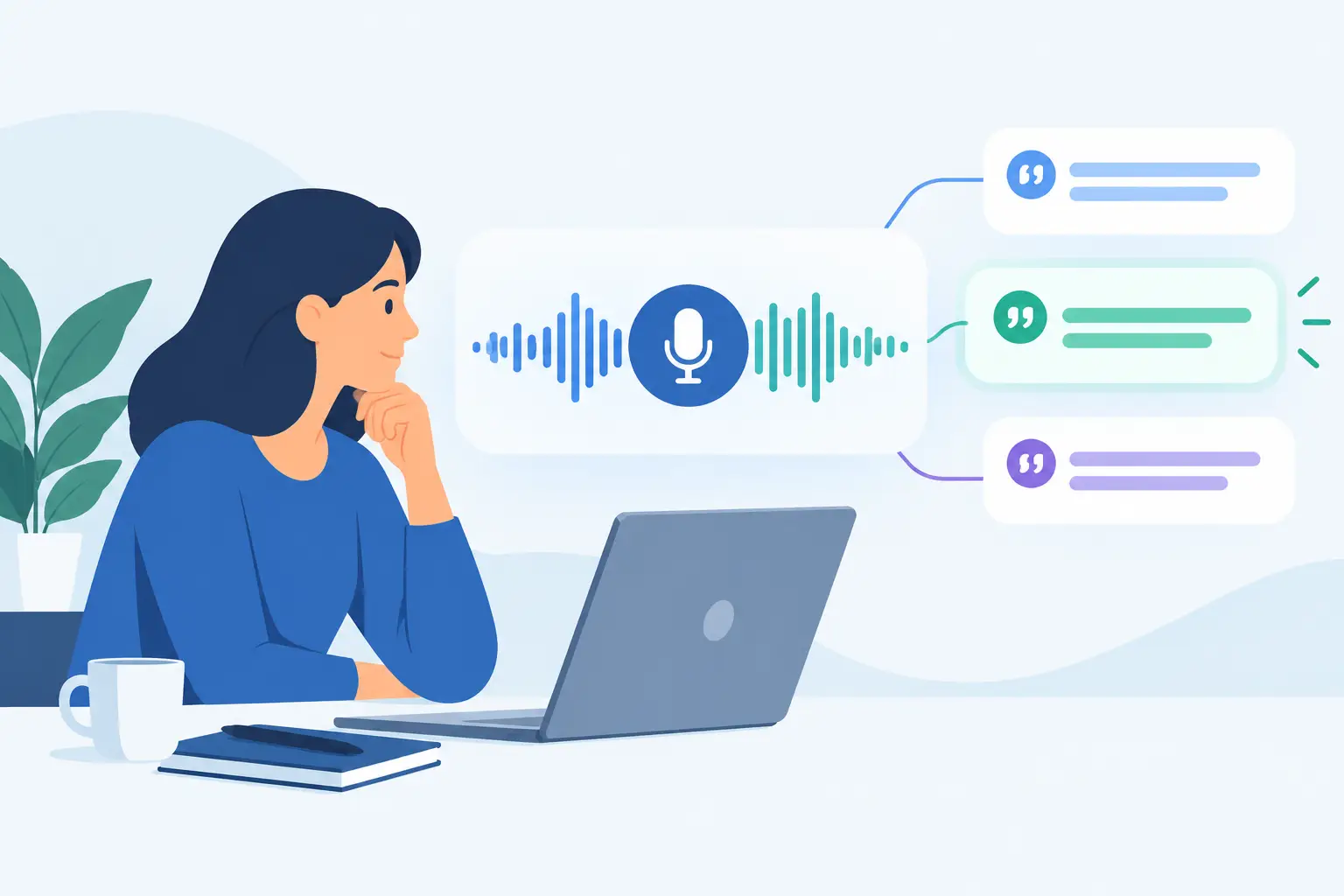
A 60-minute interview can contain one sentence that changes the direction of a story, report or client recommendation. The problem is rarely whether that sentence exists. It is how quickly you can find it again, confirm who said it and use it without misquoting the speaker. Finding quotes in recordings should not require repeated listening, rough notes and guesswork.
For professionals working with interviews, meetings, research sessions and calls, the most dependable approach is to turn audio into a searchable, timestamped record. The recording remains the source material. The transcript becomes the working document that helps you locate the right moment, check its context and act on it quickly.
Why replaying recordings is a poor quote-finding method
Listening back is necessary for verification, but it is inefficient as a primary search method. A one-hour recording may take more than an hour to review when you pause, rewind and take notes. The problem grows when you have several participants, multiple sessions or a deadline that cannot wait.
Manual notes create a second issue: they tend to capture what seemed important at the time, not necessarily what becomes important later. A journalist may initially focus on the main announcement, then need a precise comment about timing or accountability. A researcher may need to revisit an unexpected phrase used by several participants. A consultant may need the exact wording behind an agreed action.
A transcript changes the task from linear listening to targeted retrieval. Instead of asking, “Where was that moment?”, you can search for a name, topic, phrase or related term, then move directly to the relevant timestamp.
Finding quotes in recordings with a repeatable workflow
The best process is straightforward: create a transcript promptly, search broadly, verify carefully and save the quote with the information needed to use it later. Each stage matters. Speed without checking can lead to an inaccurate quotation, while careful checking without an organised record still wastes time.
Start with a clean, timestamped transcript
Upload the recording or transcribe live speech as soon as practical. A transcript produced while the conversation is still fresh gives you useful context that may be missing a week later, such as who attended, what the meeting was intended to decide or which topic prompted a strong response.
Timestamps are essential. They allow you to return to the source audio within seconds rather than scrubbing through a waveform. Speaker diarisation is equally valuable for multi-person recordings because it separates contributions and reduces the risk of attributing a statement to the wrong person.
The transcript does not need to be treated as a final published document immediately. Its first job is to make the spoken record usable. Review obvious names, technical terms and organisation names early, as these are often the terms you will search for later.
Search for ideas, not only exact wording
People rarely repeat a phrase exactly. If you search only for the quote as you remember it, you may miss the strongest version of it. Start with the central subject, then search related words, likely verbs and distinctive language.
For example, if you are looking for a comment about a delayed project, search the project name, “delay”, “schedule”, “launch”, “risk”, “ready” and the names of those responsible. In a research interview about workload, search “pressure”, “hours”, “capacity”, “stress” and “manageable”.
This method is especially useful where a transcription may contain minor inaccuracies. Speech is not always neat, speakers interrupt each other, and acronyms can be difficult to recognise. A broad search strategy gives you more paths to the same moment.
Read the surrounding exchange before selecting a quote
A sentence can sound decisive when removed from its context but mean something different in conversation. Before saving a quotation, read the preceding and following passages and listen to the relevant audio. Check whether the speaker was answering a hypothetical question, qualifying an earlier point or responding sarcastically.
This is also where transcription accuracy should be assessed. Correct any wording that affects meaning, especially numbers, names, dates, figures, legal terms and direct quotations intended for publication. If audio quality is poor, mark uncertainty rather than silently guessing.
For sensitive material, retain the timestamp even after editing the wording. It provides an audit trail back to the original source and makes later fact-checking much easier.
Save the quote with its use case
Do not leave valuable passages buried in a transcript. Create a bookmark or quote note that records the quotation, speaker, timestamp and why it matters. This small amount of structure prevents a familiar problem: finding a strong comment once, then losing it when the deadline arrives.
A useful quote record should contain four distinct fields:
- The exact verified wording, including only the edits needed for clarity or agreed house style.
- The speaker’s name, role and any attribution wording you need for the final output.
- The recording timestamp and, where relevant, the source file or session name.
- A short note explaining the theme, evidence point or section of the report where it may be used.
For long projects, add tags such as “key finding”, “case study”, “follow-up” or “publication candidate”. The purpose is not to create more administration. It is to ensure a quote can be retrieved when the work moves from review to delivery.
Match the method to the work
The underlying workflow is consistent, but the standard for quote handling varies by profession.
Journalists need speed, accurate attribution and a reliable route back to the original audio. A searchable transcript can surface a useful line quickly, but direct quotes should be checked against the recording before publication. Where an interview is on the record, preserve the source audio according to your editorial process.
Researchers often need to identify patterns across many interviews rather than select one headline quote. Search and tagging can reveal repeated language, contrasting perspectives and important outliers. In this setting, keeping speaker labels and session metadata accurate is as important as the quotation itself.
Consultants, coaches and internal teams may use quotes to document decisions, client language or agreed commitments. Here, context matters particularly because a phrase may form part of an action, concern or commercial discussion. A time-linked transcript helps colleagues verify what was said without relying on competing memories.
Podcasters and content creators can use timestamps to identify clip-worthy moments, strong introductions and precise excerpts for show notes or edits. The trade-off is that a good spoken quote is not always a good written quote. Light editing may improve readability, but it should never alter the speaker’s meaning.
Treat the transcript as sensitive working material
Recordings often contain confidential information: commercial plans, personal experiences, research participants’ identities or internal decisions. Quote-finding tools should therefore be assessed on more than transcription speed.
Check where audio and transcript data are processed, how long they are retained, who can access them and whether customer content is used to train AI models. These questions are particularly relevant for teams handling client calls, interviews under embargo or personal data. A fast workflow is only useful if it preserves control over the underlying material.
Endaxi Scribe is designed for this kind of professional use, combining timestamped transcription, speaker separation, searchable text and bookmarks with explicit retention controls, two-factor authentication and EU-based AI processing. The practical benefit is simple: teams can work from spoken information without treating privacy as an afterthought.
When search is not enough
Search cannot resolve every problem. If the recording is heavily distorted, several people speak at once or the key statement is ambiguous, careful listening remains necessary. A transcript is a powerful index, not a substitute for professional judgement.
It also pays to distinguish between a memorable statement and an usable quote. Ask whether it is accurate, representative, attributable and appropriate for the audience. In research and coaching work, a vivid quotation may still need anonymising. In business meetings, it may require confirmation before it is treated as a decision.
The most effective habit is to capture verified quotes as you review each recording, rather than postponing the task until the end of a project. When the next deadline arrives, the evidence will already be organised, traceable and ready to use.