
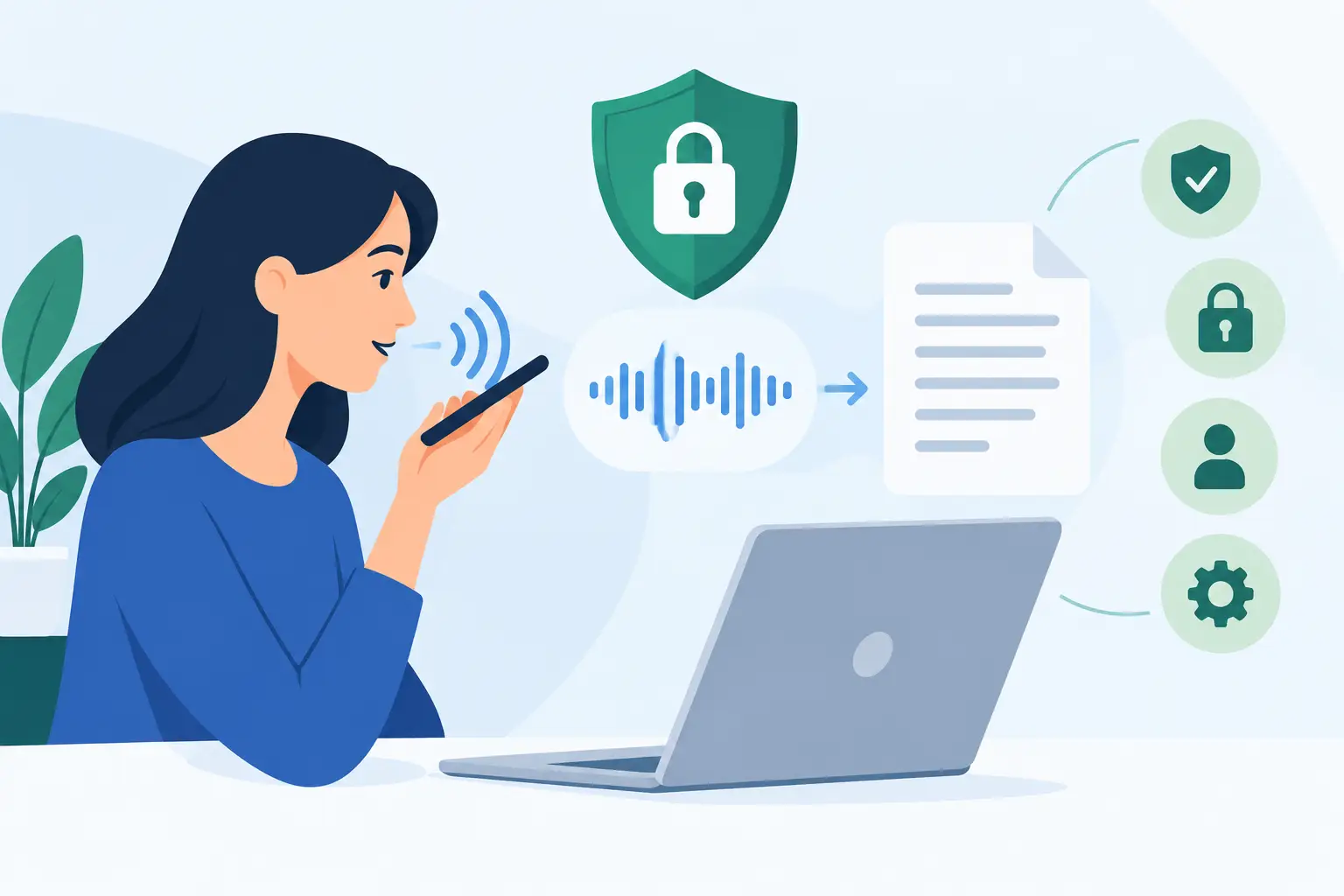
A transcription tool can save hours after an interview, client call or research session. But a fast transcript is not enough when the recording contains commercially sensitive plans, personal data, source material or private coaching conversations. This secure speech to text review sets out what professionals should assess before putting spoken work into a transcription platform.
The right question is not simply whether a provider says it takes security seriously. It is whether you can understand where your audio goes, who can access it, how long it remains available and whether your content is used for purposes beyond creating your transcript. Clear answers matter because transcription is often the point at which a private conversation becomes a searchable, shareable business record.
What makes speech to text genuinely secure?
Security is a chain of controls, not a single feature or badge. A provider may encrypt data in transit, for example, but that does not answer whether team members have appropriate access, whether deleted files are removed on a defined schedule, or whether recordings are used to train an AI model.
For working professionals, the practical standard is straightforward: you should retain control of your source material and be able to account for its handling throughout the workflow. That includes the moment you record or upload a file, the processing stage, the review process, collaboration with colleagues and final deletion or export.
A secure service should also describe its practices plainly. Vague statements about enterprise-grade protection are less useful than specific information about authentication, processing location, retention periods and data use. If a policy takes significant effort to interpret, that is itself a reason to ask more questions.
Secure speech to text review: the controls that matter
Authentication should be standard, not optional
A transcript can reveal more than a recording in some situations. It is easy to search, copy, download and forward. That makes account security the first line of defence.
Look for two-factor authentication as a standard feature across plans, rather than a paid extra reserved for larger organisations. A password alone can be compromised through reuse, phishing or an unmanaged device. Two-factor authentication materially reduces the risk that a stolen password becomes access to every recording and transcript in an account.
For teams, also consider how users are added and removed. If a contractor finishes a project or an employee leaves, their access should be easy to withdraw. Shared passwords and uncontrolled logins are not workable safeguards for a workspace containing client calls, editorial interviews or internal meetings.
Know where processing happens
Where speech is processed affects both governance and risk assessment. UK organisations handling personal information may need to understand whether their data is transferred internationally, which suppliers are involved and what safeguards apply.
A provider that processes AI workloads in the EU and does not transfer customer content to the US gives users a clearer data path. This will not remove every compliance duty, particularly where recordings include special category data or confidential third-party information. It does, however, reduce uncertainty for organisations that need to keep closer control over where data is handled.
Do not assume that the location of a provider’s headquarters tells you where audio is processed. Ask specifically about AI processing, storage and any sub-processors used to deliver the service.
Retention should be explicit and manageable
Many transcription tasks are time-bound. A journalist may need an interview transcript for a feature, a consultant may need notes from a workshop, and a researcher may need recordings for a defined study period. Keeping every source file indefinitely creates unnecessary exposure.
Defined retention windows make the lifecycle of your content easier to manage. They establish when recordings and transcripts will be removed unless you take action, rather than relying on an unclear promise that files are held only for as long as necessary.
The best retention setting depends on the work. A podcast producer may need files available throughout an editing cycle. A team handling a sensitive internal discussion may prefer a shorter period followed by an export to its own approved records system. What matters is that retention is stated clearly and that users can make a deliberate choice.
Customer content should not become model training data
This is one of the most significant distinctions between consumer-facing AI tools and professional software. Some services may use submitted content to develop, test or improve their models. That may be unacceptable when a recording includes unpublished reporting, client strategy, research participants or personal information.
A professional transcription provider should state whether customer audio and transcripts are used for AI model training. A clear commitment not to train on customer content means the material you submit is used to provide the requested service, not to improve a system for other users.
This does not mean you can ignore consent or your own data handling obligations. If you record an interview, meeting or coaching session, you remain responsible for ensuring that recording is appropriate and that participants are informed where required. The platform’s controls should support good practice, not replace it.
Access controls need to suit the way teams work
Individual users may only need a private workspace. Teams need a practical way to share transcripts without passing files through personal inboxes or creating duplicate copies on unmanaged devices.
A shared workspace can be safer than ad hoc forwarding when it lets colleagues work from the same controlled transcript. It also reduces confusion over which version contains the final corrections, bookmarks or summary. Yet collaboration should be proportionate. Not every teammate needs access to every client call or interview.
Before choosing a platform, consider who will review transcripts, who needs to export them and whether project-based access is required. The goal is to make useful collaboration easy while avoiding broad, permanent access by default.
Security should not slow down the working day
A common mistake is to treat security and productivity as competing priorities. In practice, poor workflow design often causes both risk and delay. When a transcription tool is difficult to use, people revert to personal recording apps, email attachments and scattered notes. That creates more copies of sensitive material and less oversight.
The stronger approach is to build security into a workflow that professionals will actually follow. Record live speech in the browser or upload an approved file, receive a timestamped transcript in seconds, identify speakers, correct key passages and mark important moments. Then export only what needs to leave the platform or keep the transcript in the controlled workspace while the work is active.
Features such as speaker diarisation, searchable transcripts, bookmarks and summaries are not merely conveniences. They reduce the need to replay entire recordings or circulate raw audio to people who only need a decision, quote or action point. A well-organised transcript limits unnecessary access to the original conversation.
Endaxi Scribe is designed around this practical balance: browser-based transcription and file uploads for day-to-day work, with two-factor authentication on every plan, explicit retention windows, no AI training on customer content and EU-based AI processing without US data transfers.
Questions to ask before you upload a recording
A short vendor review can prevent a difficult conversation later. Ask whether two-factor authentication is available to every user, where audio and transcripts are processed, whether customer content trains AI models, and how long files are retained. Then ask how a user can delete content, how team access is managed and what export options exist if you need to move a completed transcript into another approved system.
It is also worth testing the operational side. Upload a non-sensitive sample recording and check the quality of speaker labels, timestamps, editing tools and exports. Security controls have more value when the platform produces a transcript your team can confidently use without retyping it elsewhere.
For regulated sectors or particularly sensitive projects, involve the person responsible for information governance before rolling out a new tool. They may need to review contract terms, data processing arrangements, internal retention rules and participant consent procedures. A platform can provide the controls, but your organisation still needs a process for using them consistently.
Choose control over assumptions
The most useful transcription service is one your team can use quickly without guessing what happens to the conversation after upload. Speed, accuracy and organisation matter, but they should sit alongside defined retention, strong account protection and a clear commitment on AI data use.
When spoken information is central to your work, a transcript is not just an administrative by-product. It is a valuable working record. Treat the service that creates it with the same care you would apply to the recording itself.