
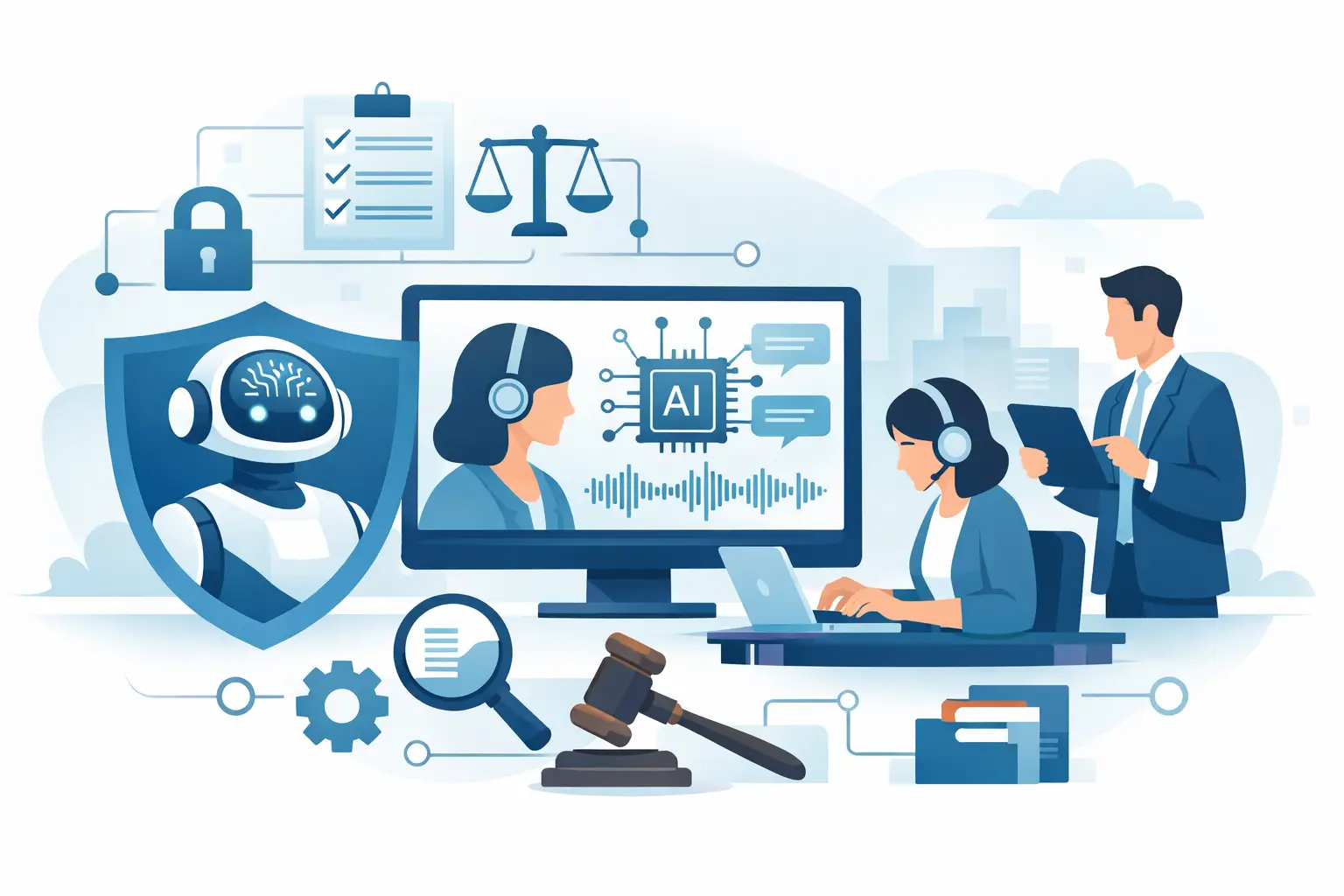
A recorded interview can contain an unpublished story, a client’s commercial plans, health information or a candid comment that was never intended for a wider audience. Once that recording enters an AI transcription workflow, AI governance determines who can access it, how long it remains available and what the provider may do with it.
For professionals who work with spoken information, this is not a policy exercise to leave to an annual compliance review. It is part of choosing a transcription tool, setting up a workspace and deciding whether a transcript can safely be shared. Good governance protects the value of fast transcription without treating sensitive material as a disposable input.
What AI governance means in practice
AI governance is the set of decisions, controls and responsibilities that guide how an organisation uses AI. In a transcription context, it covers the full path from recording or upload to transcript review, export, storage and deletion.
The question is not simply whether an AI tool is accurate. Accuracy matters, but a highly accurate transcript can still create a problem if it is stored indefinitely, visible to the wrong colleague or used to train a model without the customer’s clear agreement.
For a journalist, governance may centre on source protection and editorial access. For a consultancy, it may mean separating client workspaces and applying consistent retention periods. For a researcher, it can include consent, handling special category data and keeping a clear record of how interview material was processed. The controls will vary, but the principle is stable: spoken data needs an owner, a purpose and boundaries.
Why transcription needs clear AI governance
Audio is unusually information-dense. A single meeting recording can reveal names, opinions, account details, strategy, workplace concerns and personal context that would never appear together in a short written note. Speaker labels, timestamps and summaries make that information easier to use, which is useful – and increases the need for careful handling.
Transcription also changes the pace of work. Teams can upload a file and receive a searchable record in seconds rather than spending hours typing. That efficiency can encourage informal habits: uploading recordings to whichever tool is available, forwarding transcript exports by email or retaining every file “just in case”. These habits create risk long before anyone experiences a breach.
A practical governance approach makes the safe option the easy option. It defines approved tools, gives people clear settings and limits unnecessary collection or retention. It also gives managers a basis for checking that safeguards are being followed rather than relying on assumptions.
Data use is the first question
Before adopting an AI transcription service, establish what happens to audio and text after processing. Is customer content used to train AI models? Where is it processed? Is it transferred outside the UK or EU? Can the provider explain its retention settings in plain language?
“AI-powered” is not an answer to these questions. Professional users need a direct statement of data boundaries. A provider that does not train models on customer content, offers explicit retention windows and processes data in the EU gives teams a clearer starting point for sensitive workflows.
This matters even where a recording appears routine. An internal planning call may later become relevant to a dispute. A coaching session may include personal information. A research interview may carry commitments made to a participant. Governance should account for the likely content, not merely the file name.
Access should follow the work
Not everyone in an organisation needs access to every recording or transcript. A small team may use a shared workspace because pooled minutes and collaboration are useful, while client-specific folders still need restricted membership. A larger business may need roles for administrators, managers and contributors.
Access control is most effective when it follows the actual workflow. Ask who needs to upload, review, edit, export and delete material. Then avoid granting broader rights simply because it is convenient during setup. Two-factor authentication should be a baseline, especially for accounts that hold client interviews, meeting records or research data.
There is a trade-off here. Tighter controls can add a small amount of administration, particularly when a new collaborator joins a project. But this is generally less costly than untangling an accidental disclosure later. The goal is not to make every transcript difficult to reach. It is to make authorised access dependable and unauthorised access unlikely.
Build governance into the transcription workflow
The most useful rules are specific enough to apply on a busy day. Instead of telling staff to “use AI responsibly”, define the steps that apply before, during and after a recording.
Before recording or upload
Start with purpose and permission. Know why the conversation is being recorded, whether participants have been informed and which approved workspace will hold it. If the recording includes highly sensitive information, decide whether AI transcription is appropriate at all or whether extra safeguards are required.
Teams should also agree simple naming conventions. A transcript labelled with a project, date and interview type is easier to locate and less likely to be sent to the wrong person. Avoid putting unnecessary personal details in titles, particularly where a file may be visible in a shared workspace.
During transcription and review
Treat generated text as a working document, not an unquestionable record. AI can mishear names, industry terms, accents, overlapping speech and poor audio. Speaker diarisation can save significant time, but it should be checked where attribution matters.
This is especially relevant for journalists quoting an interviewee, consultants documenting an agreed action or researchers preparing findings. Timestamps make verification efficient: return to the exact moment in the audio, correct the transcript and retain the context. A concise AI summary can speed up review, but it should not replace professional judgement about what was said and what it means.
Keep editing and comments within the approved platform where possible. Repeatedly copying sensitive passages into unapproved tools creates extra versions that are harder to control and delete.
After export
Export only what the next stage of work requires. A colleague writing an article may need a cleaned transcript. A client may need a short action summary. An archive may require the original audio and full transcript, subject to agreed retention. These are different outputs with different access needs.
Set retention periods that reflect the purpose of the material. Leaving every recording available forever is easy, but it is rarely defensible. Equally, deleting material too quickly can undermine audit trails, editorial verification or contractual obligations. The right period depends on the project, legal requirements and the expectations set with participants.
A service such as Endaxi Scribe supports this approach by making retention and account security visible operational controls rather than vague assurances. The important point is to configure those controls deliberately and review them as workflows change.
Assign accountability, not just permissions
AI governance needs named responsibility. In a small business, this may be the founder, operations lead or person responsible for client data. In a larger team, it may sit across information security, legal, IT and the business function using the tool. Responsibility can be shared, but ownership should not be ambiguous.
That owner should be able to answer practical questions: Which transcription services are approved? What categories of recordings must not be uploaded? Who can add users to a workspace? How are retention settings chosen? What happens if a transcript is shared incorrectly?
A short internal standard is often more useful than a lengthy policy nobody reads. It should be reviewed after changes in suppliers, team structure, regulations or the types of conversations being processed. If a team begins using transcription for customer calls after previously using it only for public interviews, its risk profile has changed.
Common gaps to avoid
The weak points are usually ordinary decisions made under time pressure. Personal accounts used for business recordings, shared passwords, unclear ownership after a project ends and exports saved across multiple unmanaged devices all make control harder.
Another common gap is assuming consent solves everything. Consent to record a conversation does not automatically answer where data will be processed, who can access it or how long it will be kept. Those choices still need to be clear and proportionate.
Finally, do not confuse privacy claims with evidence. Ask for specific information about processing location, model training, authentication, retention and deletion. A provider should be able to explain these points without hiding behind technical language.
The best AI governance is rarely dramatic. It is visible in a well-configured workspace, a sensible retention rule, a checked transcript and a team that knows where sensitive recordings belong. That discipline lets professionals gain time from AI transcription while keeping control of the conversations entrusted to them.