
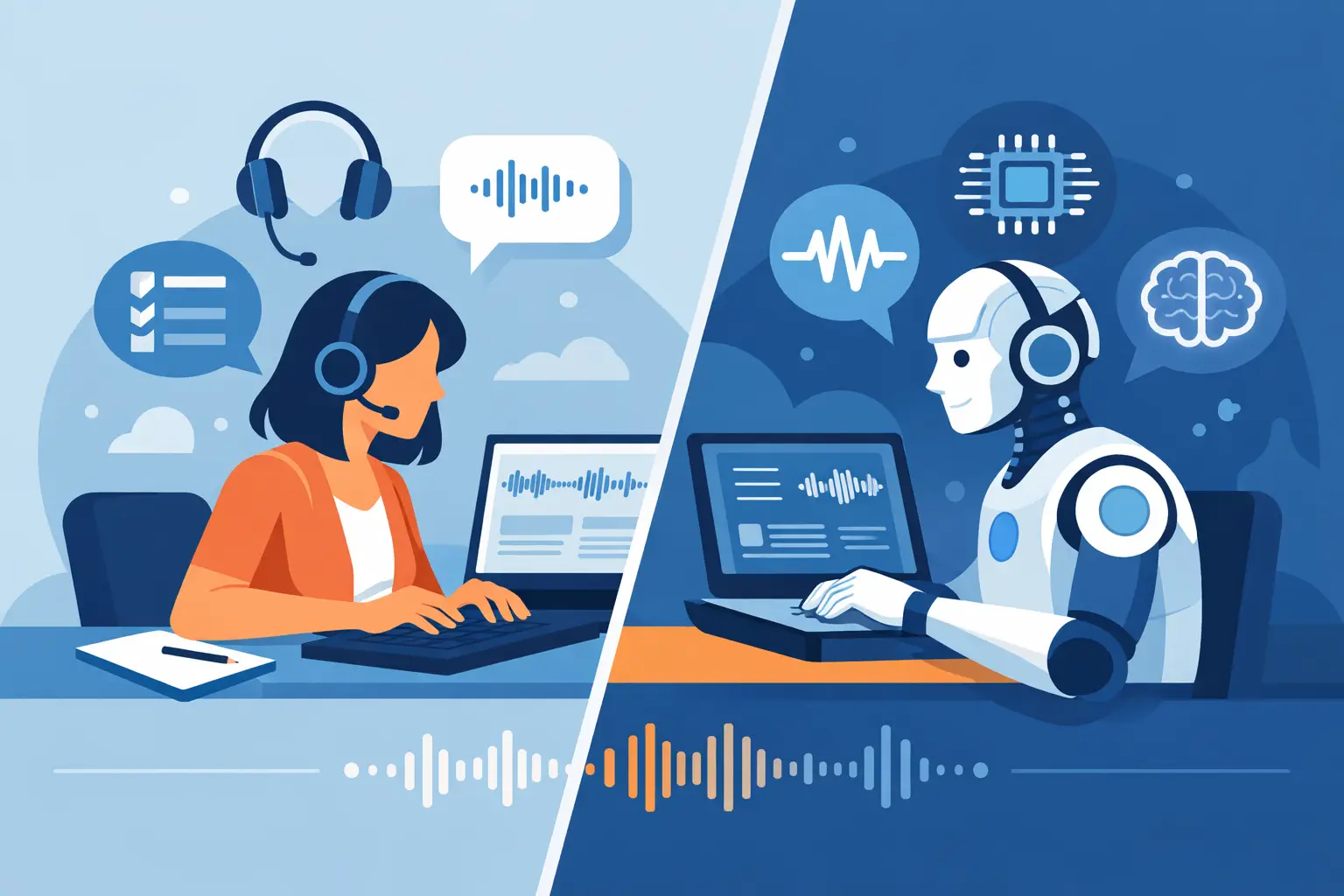
A 60-minute interview can take four to six hours to transcribe by hand. That gap between recording and usable evidence is why human transcription vs AI transcription is now a practical decision for journalists, researchers, consultants and teams – not simply a question of preference.
The right choice depends on what happens after the transcript is created. If you need to search a meeting, pull out actions, review a coaching session or create a first draft from a clear recording, AI can remove a large amount of administration. If every word may be scrutinised, quoted publicly or relied on in a formal process, human review may still be worth the additional time and cost.
Human transcription vs AI transcription: the core difference
Human transcription is produced by a trained person listening to the recording and typing what they hear. Depending on the brief, they may create a verbatim record that includes pauses, false starts and non-verbal sounds, or an intelligent verbatim transcript that removes verbal clutter while preserving meaning. A human transcriber can use context, research terminology and the flow of a conversation to resolve ambiguity.
AI transcription uses speech recognition to turn audio into text automatically. Modern systems can produce a timestamped draft within seconds or minutes, identify different speakers and make the conversation searchable. This is a major operational advantage when recordings arrive regularly and the value lies in finding information quickly rather than producing a court-ready record.
Neither method is automatically better. They solve different problems. The useful comparison is between speed, accuracy requirements, recording quality, security obligations and the cost of delay.
Speed: AI changes the working day
For most knowledge workers, speed is the clearest argument for AI transcription. A consultant can upload a client call immediately after it ends, search the transcript for decisions and send a follow-up while the discussion is still fresh. A journalist can locate a key quote without repeatedly scrubbing through an hour of audio. A research team can begin coding interviews on the same day they are conducted.
Human transcription works to a delivery schedule. Even an excellent transcriber needs time to listen closely, check difficult passages and format the document. That turnaround may be entirely appropriate for a small number of high-stakes recordings. It is less practical when every team meeting, discovery call or coaching session needs a usable record.
The time saving is not only about receiving text sooner. Search, timestamps, speaker labels, bookmarks and summaries reduce the time spent returning to the recording. A transcript becomes working material rather than an archive that is difficult to use.
Accuracy: define what accurate means for the task
Accuracy is often discussed as though it were a single score. In practice, the acceptable level of error changes with the use case. A transcript used to recall the broad direction of an internal meeting can tolerate minor mistakes. A transcript supporting a published quotation, a research finding or a sensitive HR discussion needs closer checking.
Humans are generally better at interpreting unclear speech, heavy accents, specialised language and conversational context. They can distinguish between similar-sounding words when the surrounding discussion makes the intended meaning obvious. They can also follow interruptions, overlap and changes in tone more reliably, particularly in difficult audio.
AI performs strongly when the recording is clear, speakers take turns and the language is familiar to the model. It can struggle when people speak over one another, use industry abbreviations, switch languages, speak far from the microphone or join from a noisy location. Names, figures and technical terms deserve particular attention because a plausible-looking error can be more damaging than an obvious gap.
For many professional workflows, the most effective standard is not perfection at first pass. It is a fast, high-quality draft followed by targeted review. Check the passages that will be quoted, acted upon or shared externally. Correct names, numbers, acronyms and contentious statements. This approach protects quality without returning every recording to a fully manual process.
Audio quality determines more than the tool
A poor recording creates work whichever route you choose. Clear microphone placement, a quiet room and one speaker at a time improve AI output and reduce the cost of human transcription. When recording online meetings, ask participants to use headphones where possible and capture separate speaker channels if your meeting platform supports them.
It is also worth setting expectations at the start. Ask speakers to say their name before an interview, avoid talking across one another and spell unfamiliar names or organisations. These simple habits make transcripts easier to trust and easier to review.
Cost: include the cost of waiting and reviewing
Human transcription is usually priced by audio minute or hour, with higher rates for fast turnaround, poor-quality recordings, multiple speakers or specialist subject matter. The direct cost is predictable, but can rise quickly across a large volume of meetings or interviews.
AI transcription is commonly available through a subscription or usage allowance. Its unit cost is lower, which makes it suitable for routine documentation and frequent recordings. However, low-cost output is only valuable if staff can use it confidently. If a transcript needs extensive correction every time, the apparent saving may disappear.
Consider the full cost in context. How many hours does the team spend taking notes, replaying calls and writing follow-ups? How much does it matter if decisions are delayed until someone produces a manual record? For organisations handling regular spoken information, rapid transcription often pays for itself by reducing those hidden administrative tasks.
Confidentiality and control are part of the decision
Recordings frequently contain client information, unpublished research, employee discussions, commercial plans or personal data. Choosing between human and AI transcription therefore involves more than accuracy and price.
With a human transcription provider, establish who will access the recording, where they are based, whether subcontractors are involved and how files are stored and deleted. A non-disclosure agreement alone does not answer every data governance question. You need clear operational controls.
With AI transcription, ask where audio and transcript data are processed, whether customer content is used to train AI models, who can access the workspace and how long files are retained. For UK and European organisations, processing location and international data transfers may be material to internal policy and compliance obligations.
A professional platform should make these controls easy to understand rather than burying them in vague wording. Features such as two-factor authentication, defined retention windows, workspace permissions and explicit commitments not to train models on customer content help teams handle recordings with appropriate control. Endaxi Scribe, for example, provides EU-based AI processing and gives customers clear control over retention, supporting teams that need fast transcription without treating sensitive audio casually.
When human transcription is the better choice
Human transcription remains the sensible option when nuance is central and the consequences of an error are high. This includes legal or disciplinary material, detailed qualitative research, recordings with poor audio, interviews containing complex terminology and content that must be published as precise quotations.
It can also be useful where formatting requirements are unusually strict. A human transcriber can follow a house style, flag unclear passages, apply a bespoke speaker convention and provide the editorial judgement that an automated first pass cannot.
That does not mean every minute needs manual work. You may choose a human-produced transcript for final publication while using AI-generated notes and timestamps to guide the review process.
When AI transcription is the better choice
AI is the practical default for recurring conversations where speed, searchability and organisation matter most. Think internal meetings, discovery calls, coaching sessions, podcast planning, lectures, brainstorming sessions and first-pass interview notes.
It is especially useful when the recording has more value than the notes someone could take live. Instead of choosing between participating in the conversation and documenting it, you can focus on the speaker, then return to a searchable record afterwards.
The strongest AI workflows build review into the process. Record or upload the file, generate the transcript, use timestamps to revisit important moments, correct priority details, then export or share the finished record. Speaker diarisation and bookmarks make this substantially easier on long recordings.
A practical hybrid approach
Many teams do not need to choose one method permanently. Use AI transcription for every recording that needs to be found, recalled or actioned quickly. Reserve human review for the small proportion that becomes evidence, published copy, formal documentation or high-value research material.
This model gives teams broad coverage without creating a large administrative burden. It also produces a useful audit trail: the original recording, a timestamped transcript and a record of any final corrections.
Before adopting either method, run a realistic test with your own recordings. Include different accents, typical background noise, specialist terms and the types of conversations your team actually has. Assess more than word accuracy. Check whether speakers are separated correctly, whether key names and figures survive, how quickly staff can find a decision and whether the data controls meet your organisation’s requirements.
The best transcription process is the one your team will use consistently. Make routine conversations easy to capture, give important passages the level of review they deserve, and keep control of the audio from recording through to retention.