
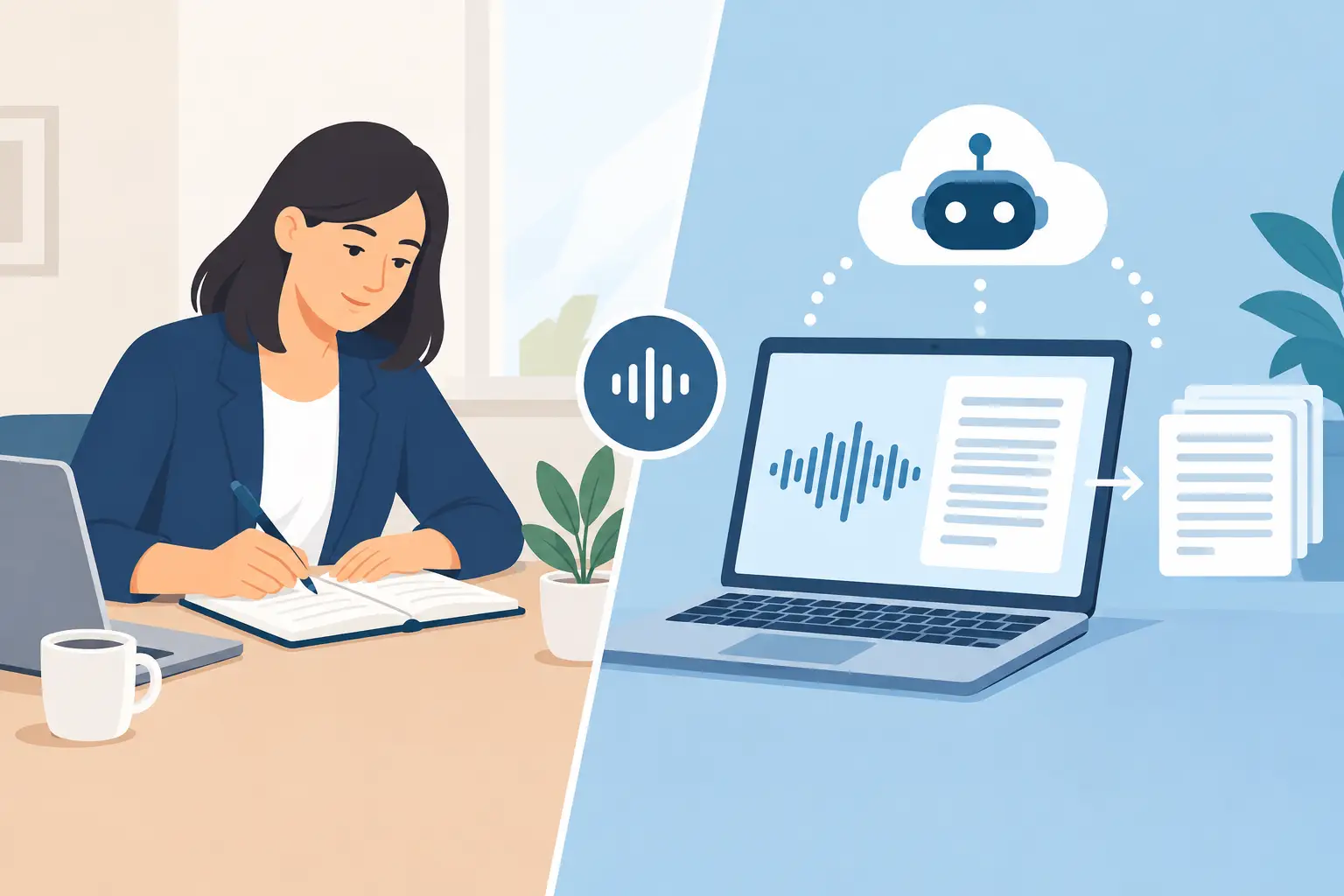
A client gives a qualifying answer halfway through a call. An interviewee names a source you need to verify. A researcher explains a caveat that changes the meaning of the data. If you are writing while trying to listen, those moments are easy to shorten, mishear or miss altogether. The choice between manual notes versus automated transcripts is not simply about speed. It determines how much of the original conversation remains available when the real work begins.
For professionals who work with interviews, meetings, coaching sessions and recorded research, the strongest approach is rarely to treat one method as a complete replacement for the other. Manual notes and automated transcripts do different jobs. Knowing where each is useful leads to better records, sharper decisions and less time spent replaying audio.
Manual notes versus automated transcripts: the core difference
Manual notes are an interpretation made in real time. They capture what the note-taker believes matters: decisions, actions, questions, risks and memorable quotes. That selectivity is valuable. A good set of notes can turn a 60-minute meeting into a useful half-page brief.
A transcript is a searchable record of what was said, with the surrounding context preserved. It does not require you to decide, during the conversation, whether a sentence will matter later. When timestamps and speaker labels are available, it also gives the team a practical route back to the exact moment in the recording.
This is the key distinction: notes are designed to compress; transcripts are designed to retain. Neither is automatically better. The right choice depends on the cost of losing detail, the need to evidence a decision, and how quickly the information must be reused.
Where manual notes still earn their place
Manual note-taking can improve attention when the task is straightforward and the outcome is known. In a weekly internal check-in, for example, you may only need agreed actions, owners and deadlines. Writing those points down creates an immediate accountability record without generating pages of material nobody will revisit.
Notes are also useful when judgement matters more than verbatim detail. A consultant listening for a client’s priorities may want to record the underlying concern, not every false start or repeated phrase. A coach may note patterns, commitments and follow-up themes while maintaining eye contact and rapport.
The limitation is that notes depend on the note-taker’s capacity and assumptions at that particular moment. Two people in the same meeting can produce different records. A rushed note may state that a decision was final when it was actually provisional, or omit the condition attached to an agreement. Once the conversation has moved on, those gaps are difficult to reconstruct with confidence.
What an automated transcript changes
An automated transcript removes the need to type every meaningful sentence while someone is speaking. After a live session or uploaded recording is processed, the conversation becomes text that can be reviewed, searched, edited and shared in the format your work requires.
That changes the working rhythm. During the call, you can make short, high-value notes such as “confirm budget” or “check claim at 18:42”, rather than trying to capture the whole exchange. Afterwards, you can search the transcript for the relevant name, phrase or decision and review the wording in context.
For journalists and researchers, this helps protect attribution and nuance. For teams, it makes it easier to verify what was agreed. For creators, it reduces the time between recording and turning spoken material into an article, outline, clip plan or show notes. The benefit is not just a faster document. It is a more complete source record.
Accuracy is more than word recognition
It is tempting to judge transcription only by whether each word appears correctly on the page. Word-level accuracy matters, particularly where names, numbers, technical terms or quotations are involved. But a useful professional record also needs context, structure and a clear review process.
Audio quality remains decisive. A clean recording with one speaker close to the microphone will generally transcribe better than a crowded video call with overlapping voices, background noise and poor connections. Accents, specialist vocabulary and proper nouns can also require correction. Automated transcription should be treated as a strong first draft, not an excuse to publish unreviewed text where precision matters.
This is where timestamps, speaker diarisation and editing tools become operationally useful. If a line looks uncertain, you can return to the audio at the relevant point rather than scan through an entire recording. If a quote will appear in a report or article, review it against the source before using it. The transcript saves the labour of creating the first version; professional judgement still protects the final version.
Manual notes have their own accuracy problem. They may be grammatically neat and concise, yet less reliable because the omitted detail cannot be checked. A transcript lets you validate the notes. In sensitive or high-stakes work, that difference matters more than a small number of correctable transcription errors.
The privacy question is part of the workflow
For many organisations, the decision is not only about convenience. Meetings can include commercial plans, client information, research participants, health-related discussions or unpublished editorial material. Sending recordings to an unknown service without understanding where they are processed, retained or reused creates an avoidable governance risk.
Manual notes may feel safer because they remain in the notebook or document controlled by the individual. Yet they can introduce their own risks: incomplete records, unprotected local files, unclear sharing practices and no consistent retention policy. Privacy is not achieved merely by avoiding transcription. It comes from controlling the full lifecycle of the information.
Before adopting an automated transcription service, establish practical answers to a few questions. Where is audio processed? Is customer content used to train AI models? Can retention periods be set or understood clearly? Who can access files and transcripts? Is account security, including two-factor authentication, standard rather than an optional extra?
Endaxi Scribe is built around this professional requirement, with EU-based AI processing, no US data transfers and a stated policy of not training AI models on customer content. Those controls do not remove the need for internal consent and data-handling policies, but they give teams a clearer basis for using speech-to-text with sensitive working material.
When each method is the better choice
Manual notes are often enough when the conversation is routine, low risk and action-focused. They work well when someone is responsible for turning a short discussion into a decision log immediately, and there is little chance that exact wording will need to be revisited.
Automated transcripts are usually the better foundation when a conversation contains evidence, detailed feedback, multiple stakeholders or material that will be reused. Interviews, discovery calls, research sessions, performance conversations, customer interviews, long workshops and recorded content all benefit from a searchable record. The more expensive it would be to replay the recording or recreate a missed point, the stronger the case for transcription.
There are also occasions when a full transcript is unnecessary. A 10-minute stand-up may not warrant one. A two-hour research interview almost certainly does. This is not about generating more documents. It is about creating the right level of record for the value and risk of the conversation.
The practical model: transcript first, notes with purpose
The most effective teams use both methods deliberately. Record the session with appropriate consent. Generate a transcript promptly. During the conversation, take only the notes that require human judgement: decisions, follow-ups, questions, reactions and moments to check later.
Afterwards, review the relevant sections rather than reading every word from beginning to end. Correct names, figures and any wording that will be quoted or relied on. Add bookmarks around key moments, then turn the transcript into the shorter deliverable the audience actually needs: a client follow-up, research summary, editorial brief, action list or project record.
This model gives you the speed of concise notes without asking the note-taker to carry the impossible burden of preserving every detail. It also means the short summary has an auditable source behind it when someone asks, “What exactly was said?”
Avoid turning transcripts into another archive
A transcript that is never reviewed or searchable in practice is only a longer version of an ignored recording. Establish simple conventions for file names, speakers, projects and retention. Keep the transcript with the work it supports, and remove it when the agreed retention period ends. For shared workspaces, make ownership and access clear from the start.
The goal is not to document every conversation forever. It is to make valuable spoken information available while it is useful, to the people who are authorised to use it.
When the next important conversation begins, keep your attention on the person speaking. Capture the decisions that need your judgement, and let a controlled, searchable transcript preserve the details you may need tomorrow.