
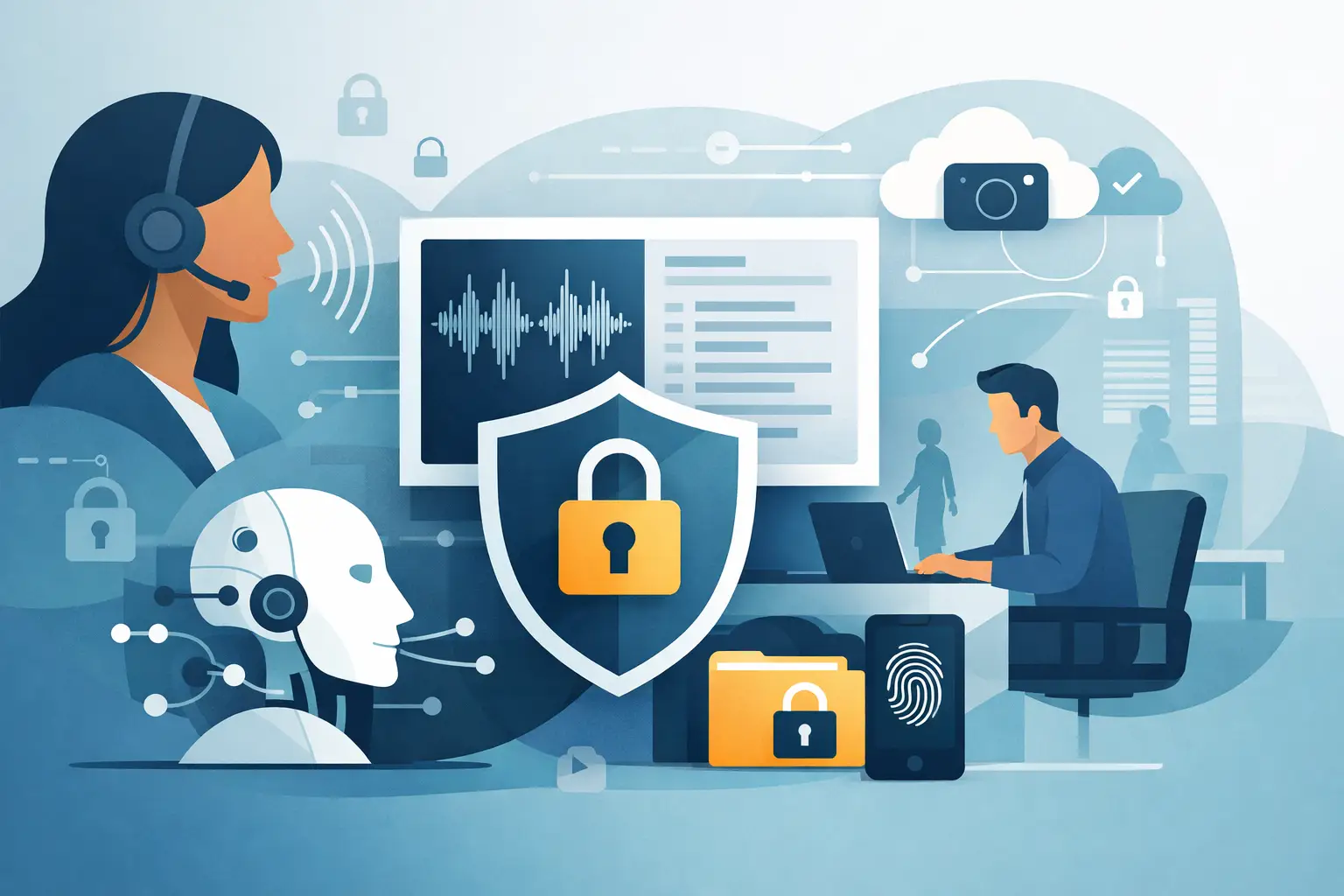
A journalist uploads an interview. A consultant records a client call. A researcher transcribes hours of qualitative audio. In each case, the value is obvious – but so is the risk. Privacy trends in AI transcription now matter well beyond IT teams, because transcription tools increasingly sit in the middle of sensitive commercial, personal and regulated conversations.
For professional users, the market is moving in a clear direction. Buyers no longer ask only whether a platform is accurate and fast. They ask where data is processed, how long it is kept, whether it trains external models, who can access it, and what control the customer has when work is done. That shift is changing how serious transcription products are built and how they are evaluated.
Why privacy trends in AI transcription are changing
A few years ago, many users treated transcription as a convenience feature. Now it is infrastructure. Meeting notes feed project records. Interviews become source material. Coaching sessions contain personal detail. Internal calls may include commercial plans, HR issues or legal discussions. Once spoken content is converted into searchable text, it becomes easier to use – and easier to expose if controls are weak.
That practical reality is driving demand for more disciplined data governance. Businesses are becoming less comfortable with vague claims about encryption and more interested in operational specifics. They want to know whether data crosses borders, whether subcontractors are involved, and whether deletion is automatic or dependent on a manual request.
This is also a response to the wider AI market. Many organisations have become wary of tools that treat customer content as fuel for future model development. In transcription, that concern lands quickly because audio often contains names, opinions, financial details and context that users would never knowingly contribute to a general training pool.
Data minimisation is moving from legal language to product design
One of the clearest privacy trends in AI transcription is the move towards collecting and storing less by default. That sounds simple, but it has concrete product implications.
Platforms are under pressure to make retention windows explicit rather than open-ended. Instead of leaving files and transcripts sitting indefinitely, stronger services now define how long data is kept and give users a clear route to remove it sooner. For professionals, this matters because forgotten archives are often the weak point. The risk is not just the original upload. It is the accumulation of months of old transcripts that no one still needs.
Data minimisation also affects feature design. A transcription platform built for professional use should not require unnecessary profile data, broad permissions or unclear sharing settings just to complete a basic workflow. The expectation is changing from collect first, justify later to collect only what the service needs to do the job.
That does create trade-offs. Some users want long-term searchable libraries of every meeting and interview. Others want automatic deletion after delivery. A privacy-conscious product needs to support both patterns without forcing one default on everyone.
Regional processing is becoming a buying criterion
Where transcription happens is becoming as important as how well it happens. For UK and European users especially, regional processing has moved from a nice-to-have to a shortlist requirement.
The reason is straightforward. Cross-border data transfers add legal and operational complexity. If your recordings include client conversations, research participants or internal business discussions, sending them through multiple jurisdictions may create questions your team would rather avoid. Keeping processing within Europe can reduce uncertainty and make procurement easier.
This does not mean every organisation has identical obligations. A solo podcaster and a research team at a university will assess risk differently. But the trend is clear: customers increasingly prefer providers that can state, in plain terms, where data is processed and whether transfers outside Europe take place.
That preference is strongest in sectors where confidentiality is part of day-to-day work rather than an abstract compliance issue. Journalists protecting source material, consultants handling commercial information and coaches dealing with personal detail all have practical reasons to care.
No-training commitments are becoming standard for serious tools
Another major shift is the growing expectation that customer audio and transcripts will not be used to train external AI models. For many professional users, this point has become non-negotiable.
The concern is not theoretical. If a platform uses uploaded content for model improvement, users need to understand what that means in practice. Is data anonymised? Can it still contain identifiable context? Is consent explicit, buried in terms, or assumed by use? For organisations handling sensitive material, uncertainty alone can rule a tool out.
This is why clear no-training commitments are increasingly valuable. They reduce ambiguity and align the service with a simple principle: the content belongs to the customer, not the vendor’s future model roadmap.
For a provider, this can mean giving up one route to product improvement. But from the user’s perspective, it supports trust and makes adoption easier across teams that need predictable guardrails.
Access control is no longer just an enterprise concern
Privacy in transcription is often discussed in terms of storage and processing, but access control is just as important. Once a transcript exists, internal exposure becomes the next risk.
This is where the market is maturing. Features such as two-factor authentication, workspace controls and clearer permission structures are no longer viewed as extras reserved for very large organisations. They are increasingly expected by small teams, agencies and independent professionals who still deal with valuable information.
A five-person consultancy may not have a formal security department, but it still needs to know who can view client transcripts, who can export them and how accounts are protected. The same applies to a producer handling interview recordings or a coach managing session notes. Good privacy practice has become part of ordinary workflow design.
This is also one area where product simplicity matters. Controls that are too complex are often ignored. The best implementations make it easy to set boundaries without slowing work down.
Transparency is replacing vague reassurance
Buyers are getting better at spotting generic privacy language. Statements such as “we take your privacy seriously” do very little on their own. What users want instead is specificity.
They want to see whether retention periods are stated clearly. They want to know whether audio is processed in the EU, whether US transfers occur, whether model training is excluded, and how deletion works. Transparency is becoming a competitive advantage because it removes guesswork during evaluation.
This is particularly relevant in B2B buying, where a tool may need approval from procurement, IT or a client-facing team lead. If the answers are difficult to find or deliberately broad, the product starts to look risky even if its underlying technology is sound.
A practical platform should make privacy easy to understand without forcing users to decode dense legal wording. Endaxi Scribe, for example, reflects this direction by putting customer control, explicit retention and EU-based processing at the centre of the product proposition rather than leaving them as footnotes.
The trade-off between convenience and control is getting sharper
Not every privacy trend points in one direction. There is a genuine tension between convenience and tighter control.
Automatic summaries, searchable archives and collaborative workspaces all add value. They also create more derived data, more stored text and more opportunities for internal sharing. For some teams, that is acceptable because the productivity gain is substantial. For others, especially those working with highly sensitive material, a shorter retention policy and narrower access model may be the better fit.
This is why the best question is rarely “what is the most private transcription tool?” It is usually “what level of privacy control matches the kind of work we do?” A newsroom, a therapy-adjacent coaching practice and a market research agency may all use transcription, but their risk profiles are not identical.
A mature buying process accepts that privacy is not one feature. It is a set of decisions about storage, access, processing location and acceptable use.
What professionals should look for next
Over the next few years, expect privacy trends in AI transcription to become even more product-specific. Buyers will ask for shorter and more configurable retention settings, stronger account protection by default, clearer regional processing commitments and straightforward statements on whether customer data is ever used for training.
They will also expect these controls to be built into normal workflows rather than sold as add-ons for top-tier plans. That is a significant change. Privacy is moving from an enterprise upsell to a baseline expectation for professional software.
For teams comparing tools, the practical test is simple. If a provider cannot explain where your data goes, how long it stays there, who can access it and whether it helps train anything else, the service is asking you to accept uncertainty. For professionals working with the spoken word, uncertainty is usually the first thing worth removing.
The most useful transcription tools will keep doing what users need them to do – turn speech into accurate, usable text quickly – while giving customers tighter control over what happens before, during and after processing. That is where the market is heading, and it is a sensible direction for anyone whose recordings contain work that matters.