
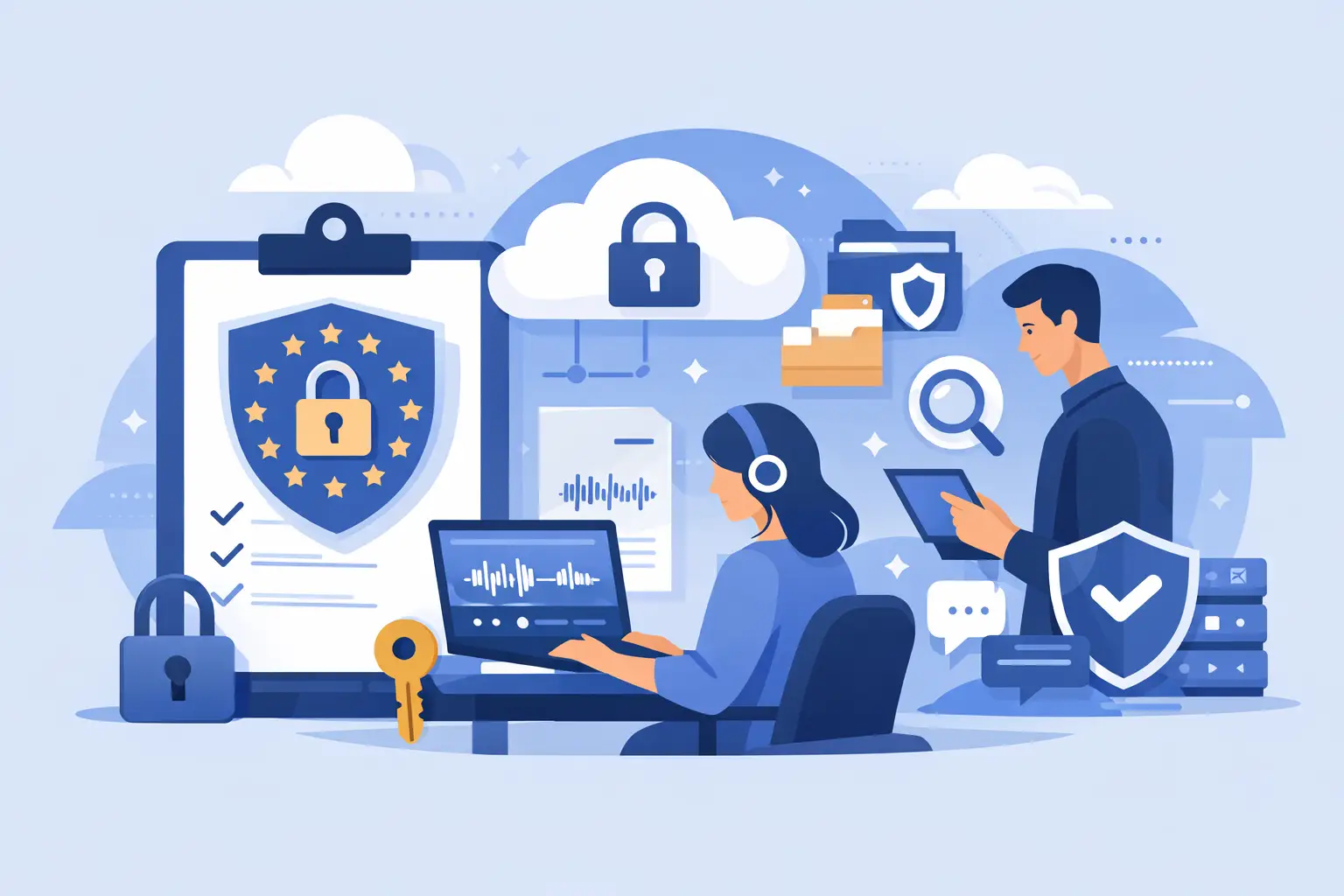
If you record interviews, meetings, coaching calls or research sessions, transcription is no longer the hard part. The harder part is choosing a GDPR compliant transcription service that does not create new risk while it saves you time. Fast turnaround is useful, but it is not enough if the provider is vague about where data goes, how long it stays there, or whether your recordings are used to train external AI models.
For most professionals, this is where procurement and day-to-day reality collide. You need transcripts in seconds, searchable text, timestamps, speaker labels and exports that fit your workflow. At the same time, you may be handling personal data, special category data, commercially sensitive discussions, or source material that should never drift into unclear processing chains. A service can be technically impressive and still be a poor fit for GDPR.
What a GDPR compliant transcription service should actually provide
A GDPR compliant transcription service is not defined by a badge, a landing page claim, or a single security feature. It is defined by the full handling of personal data across collection, processing, storage, access and deletion. That means the provider should be able to explain, in plain terms, what data it processes, for what purpose, on what legal basis, where that data is processed, who can access it, and how long it is retained.
This matters because transcription often captures more than speech. It can include names, health details, employment matters, opinions, allegations, financial information and internal strategy. In other words, the transcript itself may be more sensitive than the original recording because it is easier to search, export and circulate.
A serious provider should therefore make a few things easy to verify. You should be able to see clear retention controls, not indefinite storage by default. You should know whether processing stays in the EU or EEA, or whether international transfers are involved. You should also be told explicitly whether customer content is used for AI model training. If the answer is buried, non-specific, or framed as a future possibility, treat that as a warning sign.
Why speed alone is the wrong buying criterion
Transcription software is often evaluated on accuracy, turnaround time and price. Those are sensible criteria, but they are incomplete. If you work with journalistic material, client calls, internal meetings or research interviews, the cost of poor data governance can exceed the value of a cheap subscription very quickly.
A low-cost service may still be the right choice for public recordings with minimal personal data. It may not be the right choice for interviews with identifiable participants, commercially sensitive board discussions or coaching sessions containing personal issues. Context matters. GDPR compliance is not a decorative extra for higher-risk use cases. It is part of whether the tool is fit for purpose.
That is why the best buying question is not simply, “How well does it transcribe?” It is, “How well does it transcribe within controls that match the sensitivity of the work?”
How to assess a GDPR compliant transcription service in practice
Start with data location. If a provider says it is privacy-focused, ask where audio and transcript data are processed and stored. EU-based processing is generally simpler from a GDPR perspective because it reduces transfer complexity. If there are transfers outside the UK or EEA, the provider should explain the mechanism and the safeguards.
Then look at retention. A practical service should let you control how long files and transcripts remain available. Fixed, explicit retention windows are far better than silent long-term storage. For professionals, this is not just about compliance. It is about reducing the amount of material sitting around after the work is done.
Access controls matter just as much. Two-factor authentication, role-based permissions for teams, and clear workspace separation are basic expectations for any professional platform. If several colleagues work from the same account or share transcripts informally, you create avoidable risk. Good software should support disciplined access without adding friction.
Finally, check the provider’s position on model training. Many users now understand that an AI tool may improve itself using customer inputs unless the provider says otherwise. For business, research and media work, that line needs to be explicit. Your content should not become training material by default.
The trade-off between convenience and control
There is no point pretending every privacy-first tool will look identical to a consumer app. Some services favour convenience above all else. They may keep content accessible for longer, blur distinctions between personal and team use, or provide broad integrations without much visibility into downstream processing.
That may be acceptable for low-risk workloads. It is less acceptable when your transcript contains interview material under embargo, disciplinary discussions, participant data, or internal planning. In those cases, control is not bureaucracy. It is operational hygiene.
A well-designed service should still feel efficient. You should be able to record live in the browser or upload files, receive a clean transcript quickly, identify speakers, review key passages, correct wording where needed, and export the final text without wrestling with settings. Privacy controls should support this workflow, not obstruct it.
Features that matter for professionals handling sensitive speech
A GDPR compliant transcription service should not force you to choose between utility and governance. In practice, the strongest platforms combine both. Real-time transcription helps when you need notes as a meeting unfolds. File upload matters when you are processing interviews or recorded sessions afterwards. Timestamps make it possible to return to exact moments in the source audio. Speaker diarisation reduces manual clean-up when several people are involved.
Summaries and bookmarks can also be useful, but only if the base transcript is dependable and the data handling is sound. For many professionals, editing and export are where real work happens. A transcript is rarely the final output. It is a working record used to produce reports, articles, minutes, case notes or content. The platform should make that next step quicker without creating uncertainty around ownership and control.
This is where a product such as Endaxi Scribe stands out for business users. The practical value is not just speech-to-text in seconds. It is the combination of speed, timestamped outputs, browser-based workflow, explicit retention, two-factor authentication, EU-based AI processing and a clear commitment not to train models on customer content.
When “GDPR compliant” claims are too vague
Many services use the language of privacy because buyers expect it. The problem is that broad claims are easy to publish and hard to test. If a provider says it is GDPR compliant, ask what that means operationally.
Can you sign a data processing agreement where needed? Is retention defined? Are deletion practices clear? Is there a named approach to sub-processors and processing locations? Are security measures described in practical terms rather than abstract promises?
You do not need a law degree to spot the difference between substance and marketing. Specific answers are usually a good sign. Evasive wording usually is not.
Choosing the right fit for your work
Not every user needs the same level of control. A solo podcaster handling their own recordings may prioritise speed and editing ease. A consultant capturing client workshops will care more about confidentiality and workspace discipline. A journalist or researcher may need strong safeguards because recordings include identifiable individuals and unpublished material.
So the right choice depends on your workload, the sensitivity of your content, and how transcripts move through your organisation. If transcription is part of professional operations rather than casual note-taking, choose a service that treats governance as part of the product, not as a legal footnote.
The best transcription software should help you work faster without making you second-guess where your data has gone. That is the standard worth applying. If a provider can explain its controls clearly and still deliver accurate transcripts ready in seconds, you are looking at a tool built for real work.